2025–2026
Crises of mobility have become a key integer of social struggle in the world system. Whether one considers the explosion of different forms of movement or the production of immobility, in carcerality, wagelessness, enclosure, or via the securitization of borders, mobility and its discontents are central to radical activism across local and transnational communities.
2024–2025
The existential problems of the planet are complex. Given capitalism’s obsessive growth primed by, for instance, land-grabbing, extractivism, social and economic hierarchies, and war, capitalist environmentalism leans heavily on tweaking armageddon to maintain its hold on futurity for the planet.
2023–2024
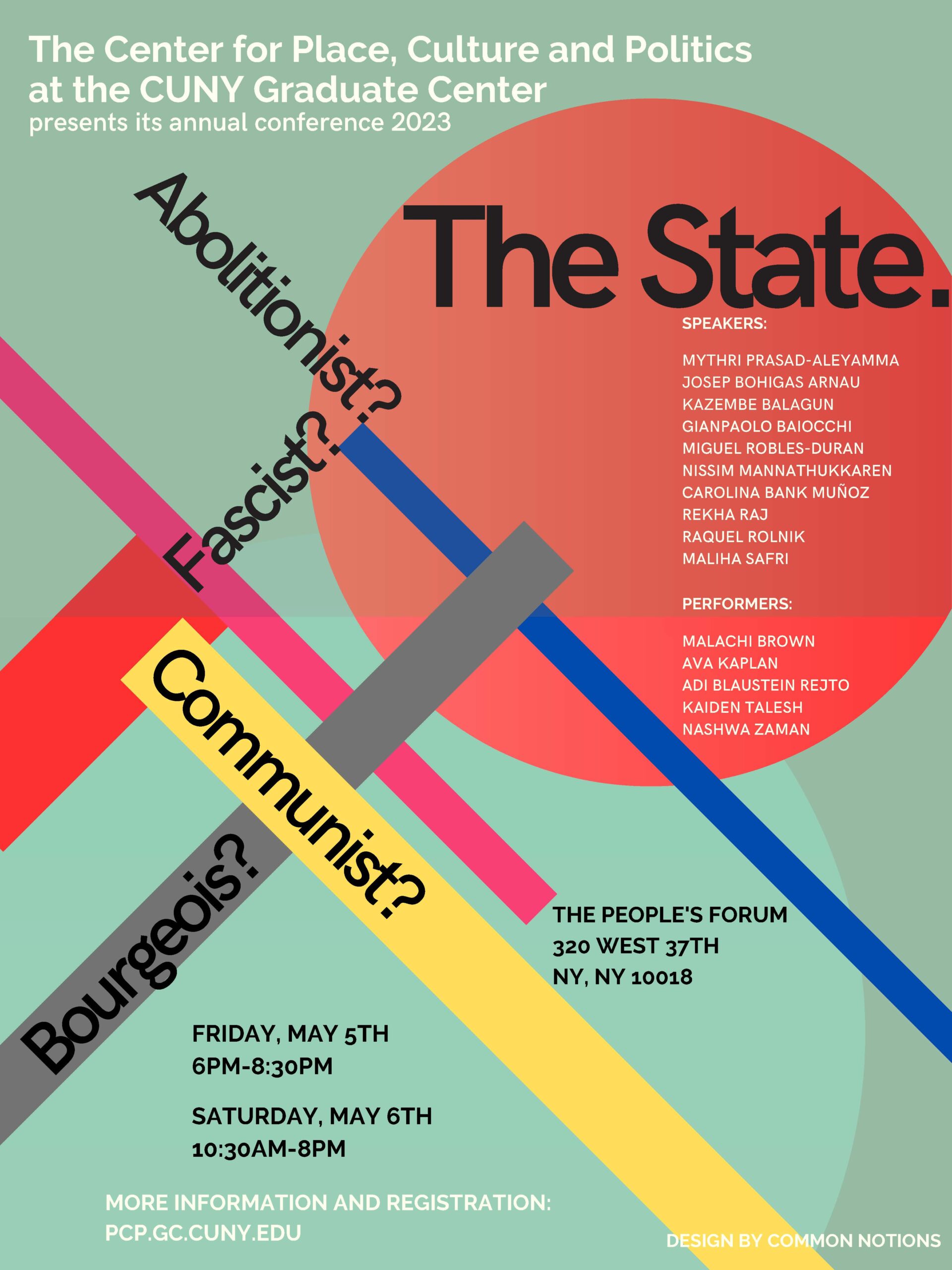
In imagining and forging the future, there is much talk of the state, but often with little detail. What should public goods consist of, and how might they be organized? Can the need for coercion (e.g., to pay taxes for public goods) be realized without the carceral and its underlying apparatuses of organized violence? What forms of sovereignty and its delegation (above or below) are possible and desirable?
2022–2023
Wary of making politics an aesthetic in disguise, radical theory and practice have nevertheless embraced all kinds of artistic provocations and traditions in every form and genre. At the same time, the possibility for fundamental change demands a range of interpretive encounters that might elicit meanings for people whom Julius Scott, writing about a different time, described as “disenchanted people casting about for new options.”
2021–2022
The material conditions of agrarian life are deeply connected to the political, social, economic, environmental and cultural challenges of contemporary existence at a planetary scale. Agrarian spaces are central to geopolitical disputes over land and other natural resources, and rural social movements play a key role in defending biodiversity and food production.
2020–2021
In the context of what appears to be inexorable urbanization, it is just as clear that agrarian questions are deeply enmeshed in the political, social, economic, and cultural challenges of contemporary existence. How have newer regimes of capital, particularly those associated with agri-business and food conglomerates, both formed and fractured agricultural communities?
2019–2020
However the international order is characterized, it is clear that various forms of internationalism are in distress. These are at work both in producing violent conflagration and in generating moving populations across the globe (migrant labor, refugees, asylum seekers, exiles, emigres, etc.). How, then, can internationalism be thought and articulated anew?
2018–2019
Given the political challenges of the present, the necessity for a deeper understanding of radical solidarity appears more pressing than ever. Yet while solidarity has been pivotal to social change since at least the Haitian Revolution, how it is articulated has never been less than problematic.
2017–2018
The place of consciousness in radical theory and practice is a subject of significant dispute, as global and local events continue to underline.
2016–2017
The place of consciousness in radical theory and practice is a subject of significant dispute. Marx believed that much of what we construe as consciousness is “false,” a rationalization or an ideological reflex that stands between people and the “true material needs” of their life processes. Are consciousness and revolution mediated in the same ways today?
2015–2016
Self-determination had a heady run in the 20th century, instanced by both revolutionary assertion and homogenizing mimicry. But what is autonomy now? What is dependence? How are these conditions of existence necessarily related – as contradictory rather than contrasting ideologies, representations, relations, outcomes? What forms reveal the dialectic at work? What forms disguise or displace the dynamic?
2014–2015
‘After Debt’ imagines a world beyond debt and pursues it as a research agenda across a broad range of intellectual inquiry. How have economic failures been transformed into personal identities, often dividing those deemed “at risk” from those capable of assuming risk? How might we understand histories of debt within genealogies of the fiscal military nation-state? What alternate meanings of dependency, obligation, risk, and credit have people produced within and against debt regimes, such as those enforced by structural adjustment?
2013–2014
Building on the past two years of seminars devoted to the theme of “Uprisings” the Center for Place, Culture, and Politics will focus its upcoming 2013-2014 seminar on questions of insurgencies, revolutions, and utopias. We propose to examine each of these phenomena as ongoing processes rather than as singular historical, present, or forthcoming events.
2012–2013
The last year has witnessed an extraordinary flowering of political and social protest across the globe. Each location of struggle, whether the revolutions sometimes called the “Arab Spring” or the vigorous demonstrations of the “Occupy Wall Street” movement, provides important lessons in how we understand social change in the current conjuncture.What is the longue durée of such struggle? How do uprisings reconfigure the social? How are they represented and is representation itself an uprising?
2011–2012
In response to contemporary crises of economics and politics one often sees polemics caught between reform and revolution but this division may be false from the position of radical politics and thought. As many have shown, reform has a more radical potential, one that takes social forms seriously enough to push their limits, to create new relations, to pose, as it were, non-reformist reform. Are there philosophical, literary, and aesthetic expressions of possibility that give us some purchase on rethinking how we do what we do?
2010–2011
Labor processes and conditions of employment in almost all sectors of the economy and most of the world have been revolutionized over the last thirty years. Generally, the share of wages in gross domestic product has declined while the share taken by capital (finance in particular) has soared. The response (or lack of it) to these new conditions has been patchy, raising questions of the state of political consciousness and political subjectivity among affected populations. Where, many ask, is the outrage and why the lack of mass protest and mass movement?